
Why Bitcoin Redefines Modern Collateral Risk
For decades, institutional risk models have been built around a simple assumption: stable assets make the safest collateral.
In traditional finance, risk departments still often favor "stable" assets like high-grade corporate bonds or prime real estate for collateral. However, this perspective overlooks a far more dangerous variable during a market crisis: Temporal Risk, or liquidation latency. An asset that is "stable" on paper but takes days or weeks to sell is effectively a liability during a margin call. For institutions seeking low-risk BTC strategies and secure custody solutions, it is time to shift the focus from price stability to liquidation certainty.
The Systemic Threat of Probabilistic Settlement
Traditional finance is structurally limited by business hours and $T+1$ or $T+2$ settlement cycles. This latency creates "probabilistic settlement," meaning a transaction is suspended for 24 to 48 hours, contingent upon the successful execution of intermediaries. This delay leads to "temporal insolvency," a critical vulnerability where an institution may have the assets to cover a margin call but cannot move them because the legacy rails are frozen, such as during a weekend crisis.
The Effective Collateral Security Formula
While critics point to Bitcoin's price volatility, mathematical models demonstrate that its ultra-fast liquidation window yields a higher effective security score than traditionally stable assets. This creates a superior framework for achieving stronger risk adjusted yield compared to slower legacy collateral systems. We can model the security of a collateral position (S) as a function of the Loan-to-Value ratio (LTV), the asset’s volatility (sigma), and the time required to liquidate (Delta):
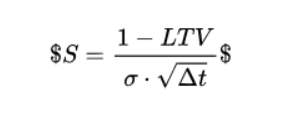
Because Bitcoin's liquidation time (Delta) is measured in minutes (10-60 minutes) rather than days, its overall security score surpasses that of bonds, equities, and real estate. By leveraging a non custodial bitcoin lending infrastructure, collateral can be mobilized and liquidated at the speed of information.
Stop relying on probabilistic settlement and vulnerable legacy rails.
👉 Download our Q1/2026 Deep-Dive Report "Beyond T+2" to explore the mathematical models behind Bitcoin’s collateral velocity and learn how to secure your operations against systemic volatility: https://debifi.com/quarterly_research_q1_26